
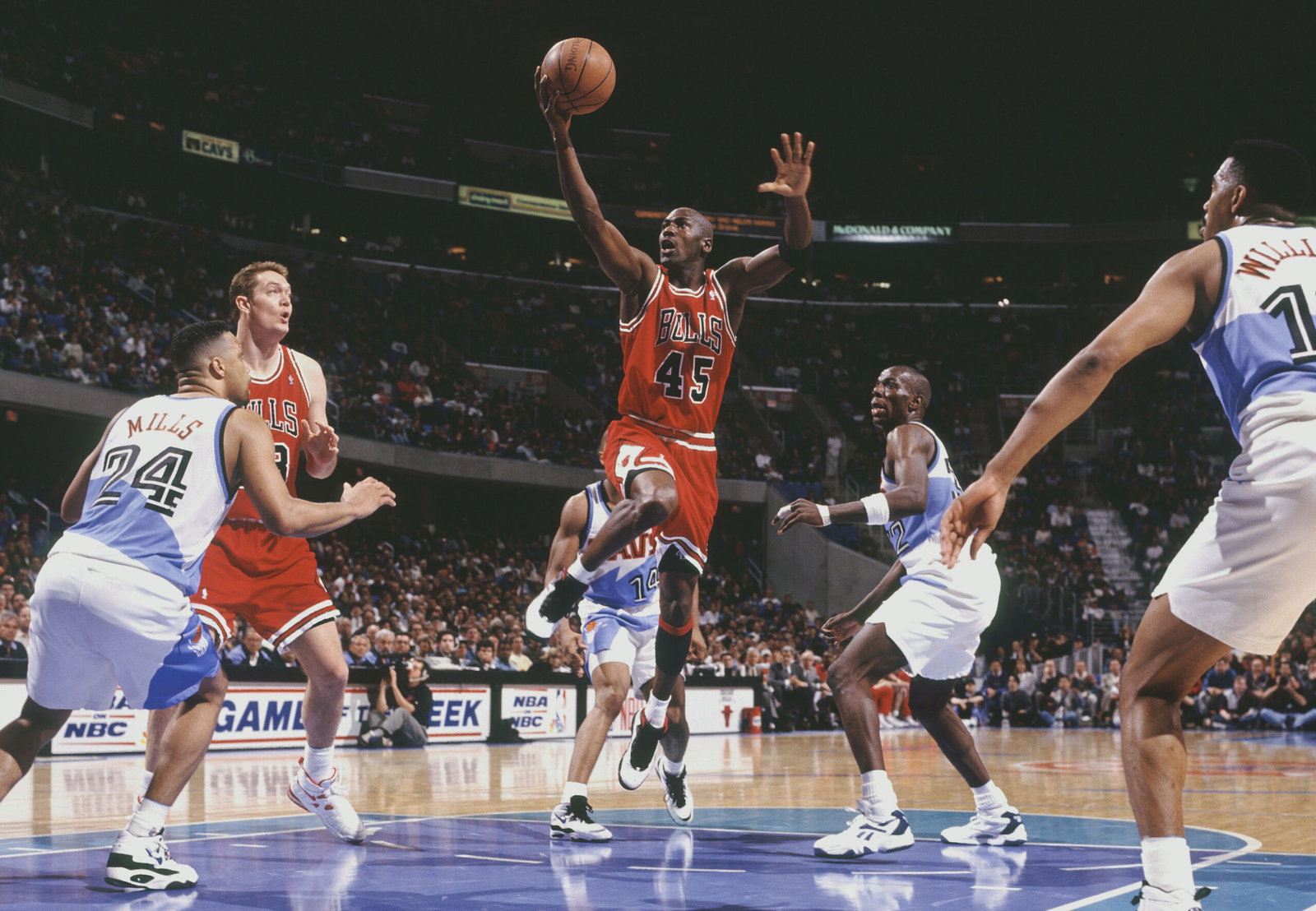
USA Today via Reuters
Unknown Date; Cleveland, OH, USA; FILE PHOTO; Chicago Bulls guard (45) Michael Jordan wears jersey#45 shortly after his return from a brief retirement following playing baseball against the Cleveland Cavaliers at Gund Arena. Mandatory Credit: Photo By USA TODAY Sports (c) Copyright USA TODAY Sports
The story everyone believes about how Michael Jordan's legendary Jumpman logo came to life is completely wrong. The truth involves a surprising inspiration that has nothing to do with basketball.
Jordan cleared the mystery behind the origin of the logo himself several years back. While most people assume the image captures a live-game dunk, the design actually came from a staged studio photoshoot for Nike back in 1985.
During an interview with HOOP Magazine in April 1997, Jordan explained exactly what happened during that photoshoot. “I wasn’t even dunking on that one,” explained Jordan. “People think that I was. I just stood on the floor, jumped up, and spread my legs, and they took the picture. I wasn’t even running."
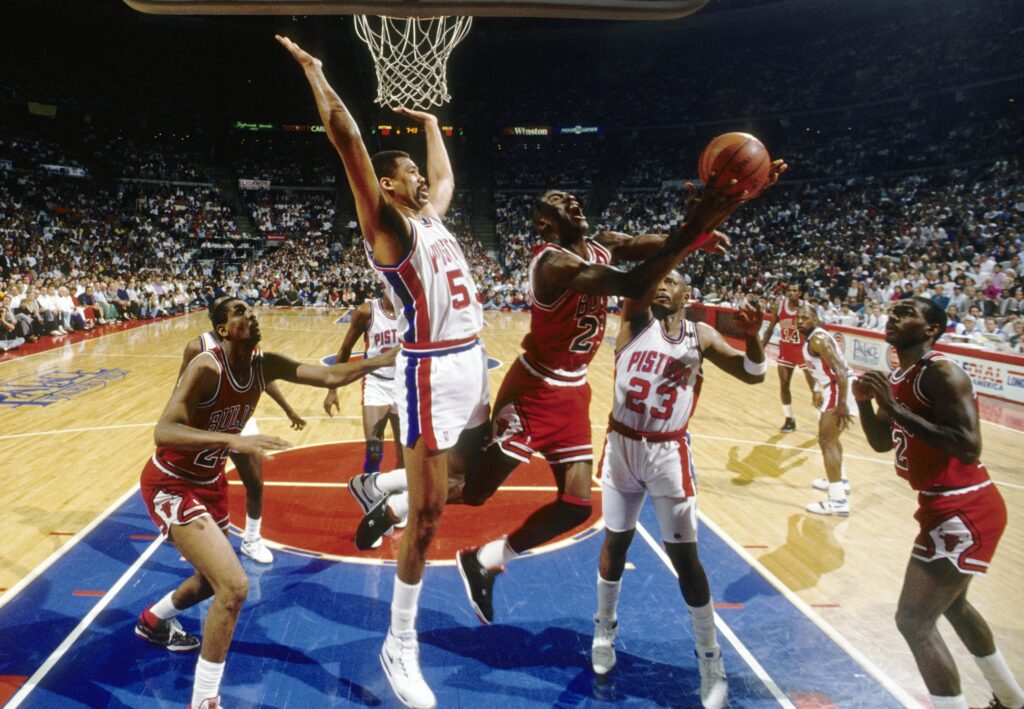
USA Today via Reuters
May 1989; Detroit, MI, USA: FILE PHOTO; Chicago Bulls guard Michael Jordan (23) is defended by Detroit Pistons center James Edwards (53) during the 1988-89 NBA Eastern Conference Finals at The Palace. The Pistons defeated the Bulls 4 games to 2. Mandatory Credit: MPS-USA TODAY Sports
Jordan continued, "Everyone thought I did that by running and taking off. Actually, it was a ballet move where I jumped up and spread my legs. And I was holding the ball in my left hand.”
The physical movement Jordan described was inspired by a classical ballet leap known as a grand jeté. While hovering, he wore his classic Chicago Bulls uniform and a pair of "Black Toe" Air Jordan 1 shoes.
The creative concept started with photographer Jacobus “Co” Rentmeester, who took a similar photo for LIFE magazine in 1984. Nike designer Peter Moore saw that image and wanted to recreate the unique pose for the new branding campaign.
Nike temporarily licensed Rentmeester's photo before setting up their own controlled shoot with Jordan. From that session, Moore took the new photo and turned the outline into a global symbol.
Even though the image was clicked in a studio, the myth only added to the brand's popularity.
How the Jumpman Became Nike’s Billion-Dollar Symbol Amid Controversy
The famous Jumpman logo did not appear on the first two Air Jordan models. The Air Jordan 1 and Air Jordan 2 used the original "Wings" logo, which was designed by Moore and Bruce Kilgore.
During the 1985-86 season, Jordan suffered a foot injury and missed most of his games. He grew unhappy with the design of the second shoe and was considering leaving Nike. To save the relationship, Nike brought in designer Tinker Hatfield to create a new shoe.
Hatfield designed the Air Jordan 3, which introduced a visible Air unit and elephant-print leather. Most importantly, he placed the Jumpman logo on the tongue of the shoe. Jordan loved the change because the personal silhouette felt much more like him than the old Wings logo.
The success of the logo eventually led to a major legal battle years later. In 2015, Rentmeester filed a copyright lawsuit against Nike in federal court. The photographer claimed that Nike copied the specific staging, angle, and expression of his original 1984 photo without his permission.
Nike fought the case by showing that their version used a different camera angle, different lighting, a different background, and unique arm and leg placements. The federal courts agreed with Nike. The U.S. Supreme Court declined to hear the final appeal in 2019, giving Nike a legal victory.
Today, the brand brings in roughly $7 billion in annual sales, making it the most profitable division under Nike.
Did you already know the real story behind the Jumpman logo?
Read more at Air Jordan Chronicles
Written by

Utsav Sinha
Edited by

Souvik Roy