
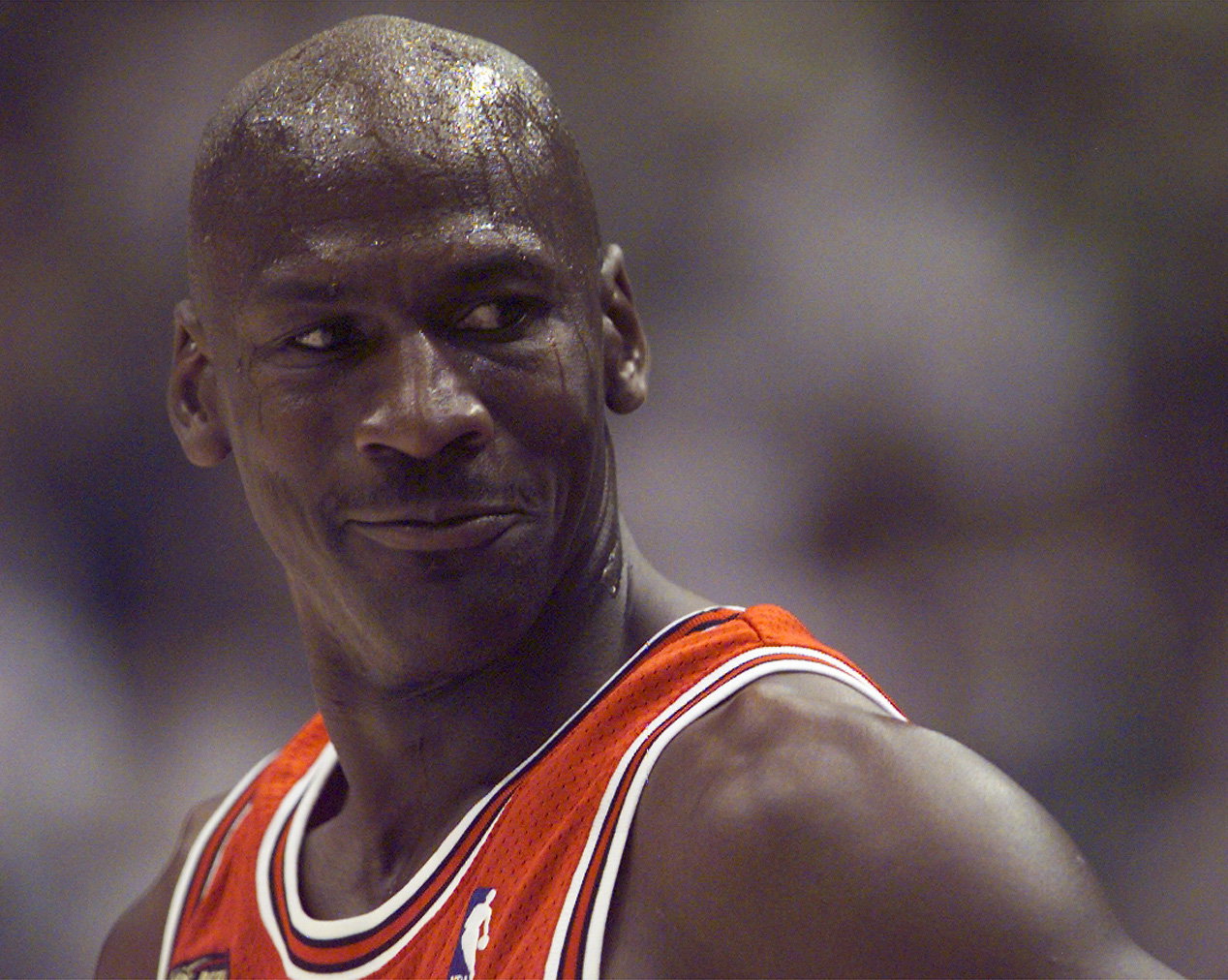
June 5, 1998; Salt Lake City, UT, USA; Chicago Bulls guard Michael Jordan in game two of the 1998 NBA Finals against the Utah Jazz at the Delta Center. Mandatory Credit: Robert Hanashiro-USA TODAY
June 5, 1998; Salt Lake City, UT, USA; Chicago Bulls guard Michael Jordan in game two of the 1998 NBA Finals against the Utah Jazz at the Delta Center. Mandatory Credit: Robert Hanashiro-USA TODAY
On January 13, 1999, Michael Jordan walked into a press conference and announced his retirement for the second time. Eight hundred reporters were in the room.
His wife, Juanita, stood nearby alongside teammates, friends, Bulls owner Jerry Reinsdorf, and NBA commissioner David Stern. Jordan was 35 years old, the reigning champion, and the best player in the world.
“Mentally, I’m exhausted,” Michael Jordan said. “Physically, I feel great. I don’t want to fool myself going into a situation knowing that I’m not 100 percent challenged mentally.”
The statement was not what the era expected from its defining athlete, as Jordan had spent his career projecting invincibility, but what he described at that press conference came from a man who had simply had enough. However, it was also a man clear-eyed enough to recognize it, calling it the “right time” while also adding that he had already made peace with the decision.
That being said, the mental exhaustion had context.
The 1997-98 season, later immortalized as The Last Dance, had played out against a backdrop of organizational fracture.
Bulls general manager Jerry Krause had made it evident that he intended to rebuild the team regardless of how the season ended. Phil Jackson, unwilling to lead a rebuild, declared it his final year. Michael Jordan, for his part, absorbed both realities and channeled them into the most focused campaign of his career.
The Bulls finished 62-20. He won his fifth regular-season MVP. In the Finals against the Utah Jazz, he averaged 33.5 points and claimed his sixth championship and his sixth Finals MVP.
Then he walked away.
Phil Jackson Tried to Keep Michael Jordan Playing After the Last Dance
Jackson’s own departure did not stop him from encouraging Jordan to continue.
He later told Jordan directly, “Michael, please don’t let your decision revolve around me.”
He also acknowledged publicly what Jordan’s exit would mean for the league. “If I leave and he retires because of that, I guess it will affect the NBA,” Jackson said.
Michael Jordan also recalled the conversations clearly.
“He didn’t have a future in front of him right now, so he considers it to be ‘The Last Dance,’” Jordan said of Jackson. “I’m the same way.”
The two had reached the same conclusion by different routes; Jackson through the organization’s decision to move on, Jordan through a mental fatigue that no championship could resolve.
Having said that, it was not Jordan’s first exit. In October 1993, after the passing of his father, James, Michael Jordan retired for the first time and briefly pursued a professional baseball career.
He returned to basketball less than two years later, in March 1995, and proceeded to win three more championships.
The 1999 retirement, however, proved more permanent.
Nevertheless, Michael Jordan made one final return with the Washington Wizards in 2001, but the Bulls chapter was closed for good on that January afternoon in Chicago.
Read more at Air Jordan Chronicles!
Written by

Shahul Hameed
Edited by

Arvind Rao