
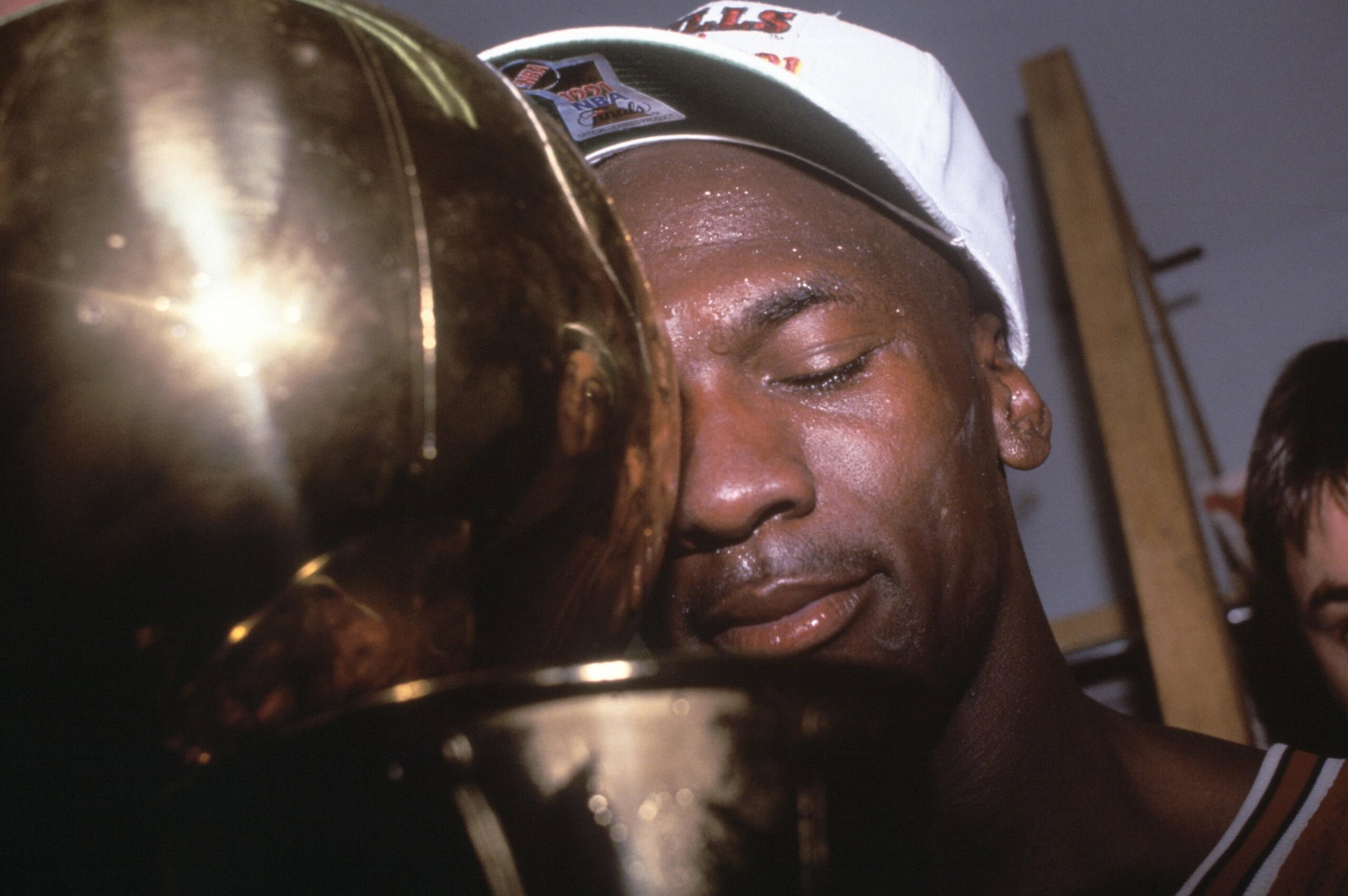
Jun 12, 1991; Los Angeles, CA, USA: FILE PHOTO; Chicago Bulls guard Michael Jordan hugs the championship trophy as he celebrates winning the 1991 NBA Finals against the Los Angeles Lakers at The Forum. The Bulls defeated the Lakers 108-101 in game5 and won the series 4-1. Mandatory Credit: MPS-Imagn Images
Jun 12, 1991; Los Angeles, CA, USA: FILE PHOTO; Chicago Bulls guard Michael Jordan hugs the championship trophy as he celebrates winning the 1991 NBA Finals against the Los Angeles Lakers at The Forum. The Bulls defeated the Lakers 108-101 in game5 and won the series 4-1. Mandatory Credit: MPS-Imagn Images
Michael Jordan dominated the NBA while playing on one of the league's most lopsided contracts. Despite earning less than rookies, the Bulls legend refused to renegotiate his deal. His commitment to a signed agreement defined his early career before his off-court empire took flight.
In 1988, MJ signed an 8-year extension with the Bulls worth $25 million, four years into his NBA career. At that time, it was indeed a lucrative deal. However, as the years passed, the salary range continued to grow, and suddenly Jordan seemed underpaid compared to the rookies in the league.
During a 1992 interview, he said, “Everybody knows I deserve more money, but I actually signed the contract.”
He didn’t want to demand a higher salary, as above all, he considered himself a ‘fair’ person.
Speaking about the changing salary market, Jordan explained, “When I signed my deal for three-and-a-quarter million or whatever I make this year, I was in the top three. Now three years later, you have rookies coming out making two-and-a-half or three million, so they’re pushing the salaries up.”
Throughout the eight-year extension, Jordan’s annual salary ranged between $2 million and $4 million. Even after completing his first three-peat, he remained in the same salary bracket for three more seasons.
Jordan never publicly demanded a salary raise either. Jordan believed complaining about a signed agreement would be unfair.
“If my boss decides to give me a raise, great, but b****** is not fair. I’ve always considered myself a fair person,” said Jordan, discussing his salary situation in 1992. The same year, he won his second championship.
However, the great baller was compensated in different ways.
Michael Jordan and his financial empire
Following his brief hiatus in 1996, he signed a one-year deal for $30.1 million for the 1996-97 season, followed by $33.1 million for the famous ‘Last Dance’ season.
Michael Jordan’s real financial game occurred off the court with his contract with Nike. The Air Jordan sneaker line, which he signed in 1984, eventually went on to become a global phenomenon. It ultimately made him the first-ever billionaire in the NBA world.
According to Forbes, MJ remains one of the highest-earning athletes ever, with a net worth of $4.3 billion. Moreover, several reports claim that Jordan made $1.3 billion with his Nike deal alone as of 2020.
What do you think of the financial legacy of Michael Jordan and the legendary Air Jordan sneakers? Let us know in the comments.
Read more at the Air Jordan Chronicles!
Written by

Shahul Hameed
Edited by

Surjo Ray